ClickHouse in the Loop for Active Agents
Low-latency analytical systems can help active agents, but only when event loops include validation, context, and safety boundaries. For teams building low-latency analytical action loops, the useful question is what changes in production and what simply sounds current.

Why Agents That Wait for Yesterday's Batch Cannot Act on Live Signals
Agents that wait for yesterday's batch cannot respond to live operational signals.
The architecture matters because agents compress the time between question, query, interpretation, and action. That matters more now because agentic analytics changes the failure mode. A human analyst may notice when a table feels stale, a metric looks odd, or a query scans too much data. An agent can move through those steps quickly and confidently unless the platform gives it clear boundaries.
The contracts that already mattered now matter more. Storage layout, catalog behavior, semantic definitions, identity, quality, and cost controls have to be explicit enough for both people and software to rely on them.
What the Docs Support
The strongest public sources for this topic are the ClickHouse documentation, Apache Kafka documentation, and the AgentTrust paper. I use those to ground the architecture and avoid treating every June 2026 announcement as a shipped production capability.
The evidence supports a few grounded points:
- Active agents need low-latency reads for event-driven decisions.
- Fast queries are not enough without validation and action constraints.
- Real-time engines and lakehouse storage can serve different parts of the same loop.
That is enough to write a useful technical article. It is not enough to make sweeping claims. I separate released behavior, design direction, and market language because readers can work with careful distinctions. They cannot operate slogans.
The Architecture Pattern
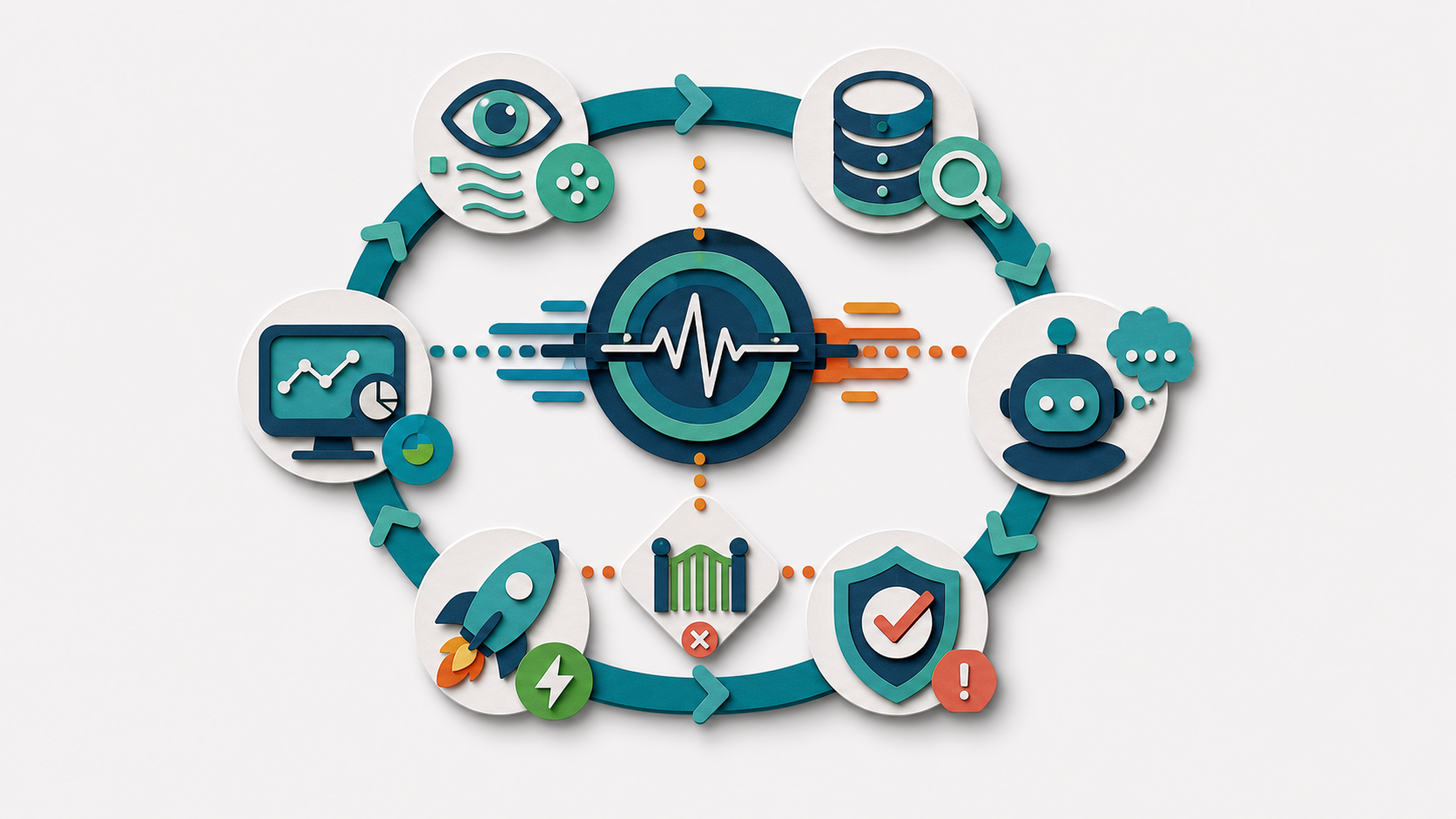
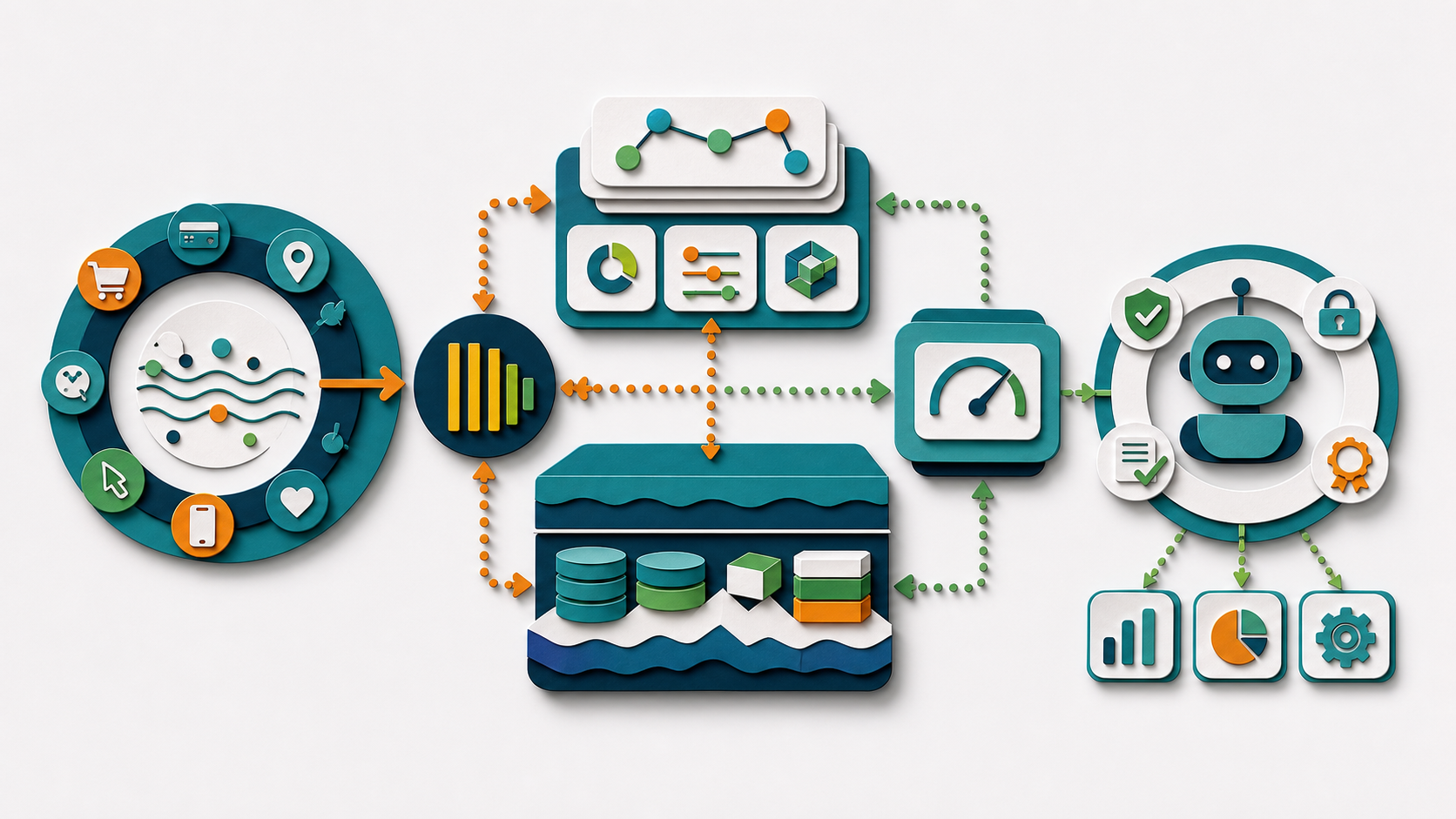
A real-time analytical loop has a live event source, a low-latency query path, a context layer, a decision step, and an action boundary. ClickHouse is often discussed for the query speed in that loop. The lakehouse remains relevant for durable historical state, governed semantic definitions, and broader analytical reuse.
For this architecture, the five layers worth keeping distinct are storage, catalog, execution, semantics, and agent interface. Storage holds durable files and snapshots. The catalog resolves identity and access. The execution layer plans and runs work. The semantic layer gives business meaning. The agent interface controls which questions and actions are allowed.
The point is not to collapse those layers into one box. The point is to make the handoffs clear. If a user or agent asks for an answer, the platform should be able to explain which table, which snapshot, which definition, which identity, and which policy shaped the result.
A Production-Shaped Example
A fraud operations agent might watch event velocity in a low-latency store, compare the pattern against historical behavior in the lakehouse, check a policy threshold, and only then trigger a review workflow. The speed matters, but the validation path matters just as much.
The test should include a happy path and at least three failure paths. One failure should involve access. One should involve stale or incompatible data. One should involve an operational problem: retry behavior, latency, file layout, or unsupported engine behavior. Those failures are where the platform either earns trust or loses it.
The test should also produce evidence. Save query IDs, snapshot IDs when relevant, policy decisions, validation output, and rollback proof. If the team cannot find that evidence after the pilot, the rollout is not ready for a wider audience.
What To Measure
Start with four specific measurements:
- Live signals separated from durable state: Confirm which questions hit the fast analytical layer and which require historical context from the lakehouse. Mixing the two without a clear routing rule creates inconsistent latency and unpredictable answers.
- Automated action bounds defined and enforced: Track whether the agent's action space is bounded. An active agent that can trigger operational workflows needs explicit action limits. Measure whether those limits fire correctly under edge conditions.
- Query latency under burst load: P95 latency under realistic traffic is more useful than average latency under light load. Agents that respond to events create burst patterns that single-user tests do not reveal.
- Action decision log completeness: Every automated action taken by the agent should produce a log entry explaining which signal triggered it, which data supported it, which policy allowed it, and what the rollback path is.
Measurements should connect to decisions. A metric that nobody uses is telemetry decoration.
Common Failure Modes
The first mistake is treating low-latency agent loops as a feature checklist. A checklist can confirm that a capability exists, but it rarely explains how the capability behaves under pressure. The better move is to write the operating contract. Name the owner, supported versions, allowed operations, denied paths, and recovery steps before widening usage.
The second mistake is ignoring boundaries. Most incidents appear where systems meet: fast analytical store to historical lakehouse, query layer to action layer, or agent tool to policy boundary. Boundary testing should be part of the rollout. If the happy path is the only path tested, the team has not tested production.
The third mistake is hiding tradeoffs behind category language. Words like real-time and active agents can be useful, but they are not a substitute for mechanics. Translate every category phrase into behavior. What changes in access, latency, correctness, cost, or auditability? If the answer is vague, the design is still vague.
The most expensive failures are usually quiet. The query is fast, but it answers the wrong business question. The event matches a threshold, but the threshold was wrong. The agent acts, but cannot explain which data or policy drove the decision. Those failures do not show up as red alerts. They show up as eroded trust.
Guardrails for Agentic Use
Agents should start with certified views, narrow tools, and explicit tool descriptions. They should not receive broad table discovery just because a human analyst has it. A tool should say what it can answer, what it cannot answer, what freshness it requires, and whether it can write or only read.
I would also require a visible refusal path. If data is stale, the agent should say so. If the question crosses a policy boundary, the agent should stop. If the action would exceed a defined threshold, the workflow should fail with a useful message. A graceful refusal is not a bad user experience. It is a trust feature.
Operational Checklist
| Area | Question to answer | Why it matters |
|---|---|---|
| Ownership | Who owns the table, catalog path, semantic definition, and agent tool? | Incidents need named owners, not shared confusion. |
| Scope | Which operations are allowed for this rollout? | A narrow launch is easier to test and govern. |
| Identity | Which human, service, or agent identities are mapped to access? | Machine-speed access needs machine-enforced policy. |
| Evidence | Which logs, query IDs, snapshots, or validation outputs are saved? | Trust needs a trail. |
| Rollback | What happens when the workflow is wrong or unsafe? | Recovery is part of the design, not an afterthought. |
This checklist is intentionally plain. If it feels too basic, that is usually a good sign. The hard part is not inventing a complex control framework. The hard part is answering the simple questions before users and agents depend on the system.
What Engineers Should Verify
Engineers should verify exact versions, APIs, identities, allowed operations, failure behavior, and audit records. Claiming "ClickHouse supports active agents" is not enough. The team needs to know which operations were tested, which latency targets were verified, and which action paths are explicitly out of scope.
The practical test is simple: can another engineer reproduce the setup, trigger a failure, understand the logs, and roll back without asking the original author for help? If not, the workflow is not ready for broader adoption.
The setup should also be tested under realistic concurrency. Many analytical designs behave well when a single analyst runs a clean demo. They behave differently when agents, dashboards, event producers, and maintenance jobs all touch the same platform simultaneously. Production readiness is about the second case.
What Data Owners Should Verify
Data owners should verify meaning. The data owner should confirm the approved datasets, definitions, exclusions, freshness expectations, and sensitivity rules. Technical correctness is not enough if the business definition is ambiguous.
This review should happen before agent exposure. Once an agent can act on a signal, people will treat the action as part of the operating rhythm. That makes weak definitions more dangerous. If a fraud threshold excludes certain account types or transaction categories, that rule should be part of the event processing contract.
Data owners should also decide when a warning is required. Some borderline events can trigger a review workflow with a visible caveat. Some events should block automated action entirely. That is a business decision, not only a platform decision.
What Executives Should Hear
The summary should be plain: ClickHouse in an active agent loop is useful when it gives agents reliable, low-latency access to validated operational signals within defined action boundaries. It is risky when speed is prioritized over correctness or when action limits are not enforced.
The value is not novelty. The value is reducing the time between a real-world signal and a governed, evidence-based operational response. That shows up in faster fraud detection, better incident response, and clearer operational audit trails.
Executives should also hear the limit. Low-latency analytical systems do not replace data ownership, quality checks, access control, and cost management. Agentic systems raise the bar for those disciplines because they can observe signals and take actions far faster than any human-only workflow.
A Good First Rollout
Start small. Pick one operational domain, one live event source, one validated historical context, one or two identities, and one measurable action workflow. Run it manually first. Then run it through the intended platform path. Then run it through the agent or automation layer.
Define success with three outcomes. The first is correctness: the action matches the expected business meaning given the signal. The second is safety: out-of-bounds actions fail clearly. The third is operability: logs and evidence are good enough for another team member to understand what happened.
After that, expand by adding another domain, another agent pattern, another event type, or another action category. Expanding one dimension at a time is slower than a dramatic launch, but it creates fewer mysteries.
Deeper Design Notes
The design work should begin with the nouns in the workflow. Name the event sources, fast query tables, historical context tables, action boundaries, owners, and failure states. When those nouns are vague, every later discussion becomes vague too. A team can spend weeks debating event-driven architecture diagrams while still failing to say which data source drives the decision or which identity is allowed to trigger the action. Start with the concrete objects and build outward.
The next step is to define the dimensions that actually change behavior: event streams, fast analytical reads, historical context, action boundaries. These are not decorative details. They determine whether the system is predictable under real use. If one of those dimensions is unknown, write it down as an open risk instead of letting it hide inside a polished diagram.
Review Questions Worth Asking
The first question is simple: what must be true before this workflow is allowed to run unattended? That question usually exposes missing assumptions about signal freshness, action limits, ownership, or rollback capability. A manual workflow can rely on human judgment. An automated workflow needs those judgments turned into checks.
The second question: what should the system refuse to do? Refusal paths are a sign of maturity. They show that the platform understands its own limits. A tool that always acts is not necessarily helpful. Sometimes the right answer is that the event pattern is too ambiguous, the historical context is unavailable, or the action would exceed the approved boundary.
The third question: who gets paged or notified when the workflow fails? If the answer is unclear, the rollout is not operationally ready. Active agent systems do not remove ownership. They make ownership more important because they can encounter edge cases faster than a human-only workflow.
A Realistic Pilot Shape
A realistic pilot should look like a fraud or operations agent checking a live spike before taking action. That scenario is intentionally narrow enough to test and broad enough to reveal platform boundaries. It should include one normal path, one stale or invalid data path, one denied access path, and one operational failure path. The point is not to make the pilot impressive. The point is to make it diagnostic.
The pilot should run in stages. First, run the workflow manually and capture the expected answer or state transition. Second, run it through the engine, catalog, or semantic path that production will use. Third, expose only the narrow tool or automation layer needed for the agentic version. If the results differ, stop and understand why before adding scope.
Include a repetition test. Run the same workflow repeatedly across a few days or a few table changes. Many systems work once. Fewer systems remain understandable after schema changes, policy changes, retries, compaction, changed workload patterns, or a new client version.
Metrics That Should Drive the Next Decision
The first metrics to watch are p95 query latency, false positive rate on triggered actions, validation step duration, and action rollback success rate. Those measurements should lead to a decision about whether to expand, tune, hold, or roll back the pilot. If the team cannot name the decision connected to a metric, the metric is probably not useful yet.
A second group of metrics should track trust: how often did the workflow return warnings? How often did it refuse correctly? How often did operators accept the action without manual review? Those signals matter because trust is not created by a fast query alone.
A third group should track cost and maintenance. Faster answers are good, but not if they create runaway event processing costs, fragile pipelines, noisy alerts, or hidden operational work. The goal is not just speed. The goal is sustainable speed with clear meaning and policy.
What I Would Cut From a Weak Rollout
Cut broad event discovery first. Agents should not scan every event stream as if every signal is equally safe and equally meaningful. Start with one validated event source, then expand when the team has evidence.
Cut write access and automated actions until read paths, audit records, and refusal behavior are boring. Actions add irreversibility, rollback complexity, and ownership questions. Some workflows need them, but they should not be the default just because the agent can call a tool.
Cut unsupported action categories from the first phase. Multi-step action pipelines are valuable, but every additional action type expands the test matrix. Start with one well-understood action. Add another when the signal validation, policy behavior, and audit trail are already clear.
The Practical Standard
The practical standard is not perfection. It is explainability under pressure. When a user challenges an action, an operator should be able to explain which signal triggered it, which data supported it, which policy allowed it, and which evidence was saved. When a workflow fails, the failure should point to the layer that needs attention.
That standard is demanding, but it is realistic. It lets teams adopt active agent analytics without pretending that speed makes data quality or action governance disappear. The agent is one participant. The platform contract is what makes the action trustworthy.
My Recommendation
Take ClickHouse in active agent loops seriously, but do not oversell it. The useful bar is simple: can the team explain the contract, test the behavior, enforce the policy, measure the result, and recover from failure?
If the answer is yes, the pattern deserves a production pilot. If the answer is no, the next step is not a bigger announcement. The next step is a narrower contract and a better test.
This is also where open lakehouse platforms like Dremio complement fast analytical engines. Live systems still need semantic context, durable history, and governed SQL access. ClickHouse handles the speed. The lakehouse handles the meaning. When both layers are well-governed, the agent loop becomes trustworthy.
For a deeper foundation on lakehouse and AI architecture, explore Alex Merced's books on data lakehouses and AI at books.alexmerced.com. To try a governed, open, agent-ready lakehouse in practice, start a free trial of Dremio's Agentic Lakehouse at dremio.com/get-started.